
Vietnam Work Permit 2026 regulations are undergoing significant changes. On December 5, 2026, Decree No. 393/2026/ND-CP (Decree 393) will officially take effect, replacing Decree No. 219/2025/ND-CP (Decree 219) and introducing 12 important changes affecting foreign employees and employers in Vietnam.
The new decree introduces more flexible qualification requirements for experts and executive directors, simplifies work permit extension procedures, and expands the use of government databases.
At the same time, certain work permit exemption categories, particularly intra-company transfers and short-term employment, will face stricter conditions. Employers will also be subject to additional responsibilities regarding foreign workforce management and reporting.
For businesses employing foreign nationals in Vietnam, understanding these changes is essential to preparing the correct documentation, meeting application deadlines, and maintaining compliance with Vietnamese labor regulations.
68 SOLUTIONS – Legal & Travel explains the 12 major changes under Decree 393/2026/ND-CP and what employers should know before December 5, 2026.
68 SOLUTIONS – Professional Work Permit Consultation and Support in Vietnam

With the introduction of Decree 393/2026/ND-CP, understanding the applicable work permit requirements and preparing the correct documents will become increasingly important for foreign employees and employers in Vietnam.
68 SOLUTIONS – Legal & Travel provides professional consultation and administrative support for businesses, organizations, and foreign nationals navigating Vietnam’s work permit procedures.
Our services include:
- New Work Permit Consultation: Reviewing eligibility requirements for managers, executive directors, experts, and technical workers, including qualifications, experience, and supporting documents.
- Work Permit Extensions: Advising on extension eligibility, application timelines, and required documentation.
- Work Permit Reissuance: Providing guidance when an existing work permit needs to be reissued under the applicable regulations.
- Work Permit Exemption Consultation: Identifying eligible exemption categories and advising on exemption certificates or notification requirements.
- Criminal Record and Medical Certificate Support: Advising on document preparation, validity periods, and requirements for overseas-issued documents.
- Translation, Certification, and Consular Legalization: Assisting clients with identifying and arranging the relevant documentation procedures.
- Decree 393 Compliance Guidance: Reviewing new requirements, work permit documentation, deadlines, and transitional provisions.
Whether your company is hiring foreign employees, arranging intra-company transfers, or preparing upcoming work permit extensions, our team can help you understand the applicable procedures and prepare accordingly.
Need guidance on Vietnam’s new work permit regulations? Contact 68 SOLUTIONS for case-specific consultation.
Contact Information
- Website: https://68solutions.vn/
- Hotline / Zalo / WhatsApp: (+84) 935 595 536
- Email: sales@68solutions.vn
Overview: 12 Major Changes Under Vietnam’s Decree 393/2026/ND-CP
Decree 393 introduces changes across four main areas.
Relaxed Requirements: Broader expert eligibility, reduced experience requirements for certain executive directors, and simplified work permit extension procedures.
Stricter Requirements: Revised work permit exemptions, restrictions on intra-company transfers and short-term employment, and additional employer responsibilities.
Digitalization: Greater use of government databases to replace certain documents in application procedures.
Procedural Adjustments: Changes to application deadlines and the calculation of working days.
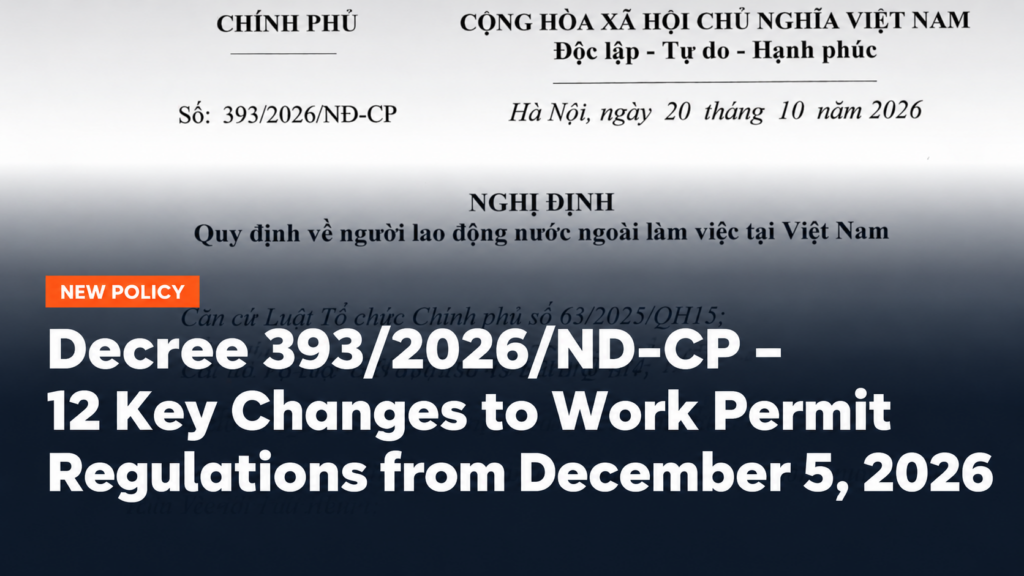
Below are the 12 key regulatory changes employers and foreign workers should understand.
A. Relaxed Requirements Under Decree 393/2026/ND-CP
1. Work Permit Exemption Categories Expanded From 15 to 18
One of the most notable changes under Decree 393 is the expansion of work permit exemption categories from 15 to 18 cases.
The newly introduced categories include:
- Foreign nationals holding special visa exemption cards.
- Experts working in strategic technology fields and their eligible family members.
- Foreign professionals involved in artificial intelligence workforce development.
Additionally, certain foreign employees working in the education sector will no longer need confirmation from the Ministry of Education and Training under the revised provisions.
These changes expand the circumstances in which eligible foreign nationals may work in Vietnam without obtaining a conventional work permit.
However, the applicable requirements for obtaining an exemption certificate or completing a notification procedure must still be considered.
Legal Reference: Clauses 14, 16, 17, and 18, Article 8 of Decree 393/2026/ND-CP.
2. Expert Qualification Criteria Expanded From 2 to 6 Categories
Decree 393 significantly broadens the criteria for classifying foreign employees as experts, increasing the number of qualifying categories from two to six.
The additional qualifying circumstances include:
Graduates in Strategic Technology Fields
Foreign nationals holding university degrees in designated strategic technology fields may qualify as experts without a professional experience requirement under the applicable category.
Outstanding Graduates From Top 500 Universities
Foreign nationals graduating with excellent academic results in eligible fields from universities ranked among the world’s top 500 may qualify with at least one year of relevant professional experience, subject to the specific criteria.
Experts in Culture, Arts, and Sports
Additional qualification pathways are provided for foreign professionals working in cultural, artistic, and sports-related fields.
Teaching and Scientific Research Professionals
Certain foreign employees engaged in teaching, scientific research, and academic activities may qualify under specific expert criteria.
Professionals With Five Years of Relevant Experience
Foreign nationals with at least five years of professional experience relevant to their intended position in Vietnam may qualify as experts without holding a university degree under this category.
The expanded criteria provide additional qualification pathways for experienced professionals and individuals working in specialized fields.
Legal Reference: Clause 3, Article 4 of Decree 393/2026/ND-CP.
3. Executive Director Experience Requirement Reduced From 3 to 2 Years
Under Decree 393, the professional experience requirement for certain executive directors will be reduced from three years to two years.
This applies to foreign employees who head and directly manage a particular business function or operational area, as specified in the decree.
The adjustment relaxes the experience requirements for this category of foreign management personnel.
Legal Reference: Point b, Clause 2, Article 4 of Decree 393/2026/ND-CP.
4. Faster and Simpler Work Permit Extensions
Decree 393 introduces several improvements to Vietnam’s work permit extension procedures.
The main changes include:
- Processing time: Reduced from 10 working days to 5 working days.
- Application window: Employers may apply up to 90 days before expiration, compared with 45 days previously.
- Medical certificates: No longer required for work permit extension applications.
- Vietnamese worker recruitment notices: No longer required for the extension procedure.
These adjustments reduce certain documentation requirements and shorten the statutory processing time for work permit extensions.
Employers must still submit extension applications at least 10 working days before the existing work permit expires.
Legal Reference: Articles 28 and 29, and Form No. 03 of Decree 393/2026/ND-CP.
5. Medical Certificates Issued Overseas Will Be Accepted
Decree 393 allows medical examination certificates issued by authorized foreign healthcare facilities to be accepted without requiring an international treaty or mutual recognition agreement.
The medical certificate must have been issued within 12 months before the application submission date.
Overseas-issued medical certificates remain subject to applicable consular legalization, Vietnamese translation, and certification requirements unless a relevant exemption applies.
Legal Reference: Clause 2, Article 9 and Clause 2, Article 19 of Decree 393/2026/ND-CP.
B. Stricter Requirements for Foreign Workers and Employers
Although Decree 393 relaxes certain eligibility requirements, it also introduces stricter rules concerning work permit exemption arrangements and employer responsibilities.
6. Technical Workers Excluded From the Intra-Company Transfer Category
Under the revised intra-company transfer provisions, only the following categories of foreign workers qualify:
- Managers.
- Executive Directors.
- Experts.
Technical workers will no longer qualify under the intra-company transfer category solely on the basis of their technical worker classification.
However, the maximum validity period of a Work Permit Exemption Certificate issued under the qualifying intra-company transfer arrangement will be extended to three years.
Decree 393 also includes transitional provisions for work permits and exemption certificates previously issued to technical workers under intra-company transfer arrangements.
Legal Reference: Clause 1, Article 3; Clause 3, Article 11; and Clause 3, Article 35 of Decree 393/2026/ND-CP.
7. Stricter Rules for Short-Term Employment Under the 90-Day Exemption
Decree 393 clarifies how short-term working periods must be calculated.
The total number of days worked in Vietnam must be calculated cumulatively across one or multiple employers, with a maximum of 90 days within a calendar year under the relevant short-term arrangement.
Importantly, where an employment relationship involving recruitment, utilization of labor, and salary payment in Vietnam arises, the employer must apply for a work permit under the labor contract arrangement.
These provisions clarify the scope of short-term work permit exemptions and restrict their use where a local employment relationship exists.
Legal Reference: Clause 5, Article 3 and Point a, Clause 13, Article 8 of Decree 393/2026/ND-CP.
8. Criminal Record Documentation Required for Work Permit Exemption Certificate Applications
Another significant change concerns applications for Certificates of Work Permit Exemption.
Under Decree 393, criminal record documentation becomes a required component of the standard exemption certificate application procedure.
However, applicants are not required to separately submit a criminal record certificate where the competent authority can retrieve the necessary information from the criminal record database under the prescribed conditions.
Certain simplified exemption certificate procedures also have different documentation requirements.
Legal Reference: Clause 6, Article 9 of Decree 393/2026/ND-CP.
9. Expanded Notification Requirements for Changes in Work Location
Decree 393 expands the circumstances in which employers must notify the competent authorities about changes in a foreign employee’s work location.
The notification requirement applies when a foreign employee:
- Begins working at a new location.
- Changes to another workplace on a stable or regular basis.
Importantly, the requirement may apply even when the new workplace is located within the same province.
Employers must notify both the competent authority where the relevant document was issued and the competent authority responsible for the intended workplace.
Legal Reference: Clause 5, Article 10 and Clause 5, Article 23 of Decree 393/2026/ND-CP.
10. New Employer Responsibilities and Biannual Reporting Requirements
Decree 393 directly establishes additional responsibilities for employers engaging foreign workers in Vietnam.
Two significant obligations include:
Prohibition on Labor Subleasing
Employers are prohibited from subleasing foreign workers.
Biannual Foreign Workforce Reporting
Employers must submit periodic reports on their utilization of foreign employees twice a year, subject to the applicable reporting provisions.
The specified reporting deadlines are:
- Before June 5 each year.
- Before December 5 each year.
These requirements emphasize the responsibility of employers to manage foreign labor lawfully and maintain appropriate workforce records.
Legal Reference: Clause 6, Article 37 of Decree 393/2026/ND-CP.
C. Digitalization of Vietnam Work Permit Procedures
11. Government Databases Will Replace Certain Application Documents
A key direction of Decree 393 is the increased use of government databases to reduce certain documentary requirements.
The relevant changes include:
Criminal Record Database
Information retrieved from the criminal record database may replace the submission of a separate criminal record certificate under the prescribed conditions.
National Immigration Database
Passport information may be retrieved from the national immigration database instead of requiring a separate copy where the relevant data can be accessed.
Foreign Worker Database
Information maintained in the foreign worker database may replace certain documents, including:
- Applicant photographs.
- Copies of previously issued work permits.
- Copies of previously issued Work Permit Exemption Certificates.
These exemptions from documentary submission apply where the relevant information can be retrieved from the appropriate database.
Additionally, passports are not subject to consular legalization requirements.
The changes reflect a stronger shift toward digital administrative procedures and electronic data verification.
Legal Reference: Articles 6 and 7, together with Articles 9, 13, 16, 19, 25, and 28 of Decree 393/2026/ND-CP.
D. Changes to Application Deadlines
12. Certain Deadlines Will Be Calculated in Working Days
Decree 393 adjusts how certain deadlines are calculated for work permits and Certificates of Work Permit Exemption.
Work Permit and Exemption Certificate Applications
The relevant issuance and extension applications must be submitted at least 10 working days before the applicable commencement or expiration date.
Returning Expired Work Permits and Exemption Certificates
The deadline for returning expired work permits or exemption certificates will be 10 working days, replacing the previous 15-day period.
Employers should therefore review their internal application schedules and ensure that the distinction between working days and calendar days is properly reflected in their procedures.
Legal Reference: Clause 1 of Articles 10, 17, 23, and 29; and Clause 1 of Articles 32 and 34 of Decree 393/2026/ND-CP.
What Should Employers Prepare Before December 5, 2026?
The changes introduced by Decree 393 will directly affect how employers recruit, manage, and prepare legal documentation for foreign employees working in Vietnam.
Businesses should pay particular attention to revised expert and executive director eligibility requirements, intra-company transfer restrictions, short-term employment conditions, work permit exemption documentation, and applicable filing deadlines.
Employers should also review their internal processes for workplace notifications, government database verification, and foreign workforce reporting.
By understanding these changes before the effective date, employers can prepare their documentation in advance and reduce the risk of unnecessary application amendments or administrative delays.
Contact 68 SOLUTIONS for Work Permit Consultation Under Decree 393
Understanding new legal requirements can be challenging, especially for employers managing multiple foreign employees or preparing applications during a regulatory transition.
68 SOLUTIONS – Legal & Travel provides consultation and administrative support relating to work permit issuance, reissuance, extensions, and exemption procedures for foreign nationals working in Vietnam.
If your company needs clarification on the changes introduced by Decree 393/2026/ND-CP, our team can assist in reviewing the applicable conditions and identifying the appropriate documentation for your circumstances.
68 SOLUTIONS – Legal & Travel
Website: https://68solutions.vn/
Hotline / Zalo / WhatsApp: (+84) 935 595 536
Email: sales@68solutions.vn
Office: 6th Floor, 117 Hoang Cau Street, Dong Da Ward, Hanoi, Vietnam.
Legal Source: Decree No. 393/2026/ND-CP dated October 20, 2026, regulating foreign employees working in Vietnam.
Disclaimer: This article provides general legal information based on the 12 major changes identified in the comparative legal memorandum concerning Decree 393/2026/ND-CP and Decree 219/2025/ND-CP. The application of these regulations depends on the circumstances of each case, relevant transitional provisions, and instructions from competent Vietnamese authorities.