
The Apostille Convention, also known as the Hague Convention of 1961, simplifies the authentication of public documents for international use. Since September 11, 2026, Vietnam has officially implemented the Convention, allowing eligible documents to be used between Vietnam and other participating countries without traditional consular legalization.
According to the Hague Conference on Private International Law (HCCH), the Convention currently has 130 Contracting Parties, including Vietnam. However, the Convention is applicable between Vietnam and 125 other Contracting Parties as of September 11, 2026.
This article by 68 SOLUTIONS – Legal & Travel provides an updated list of Apostille Convention countries, explains the exceptions applicable to Vietnam, and identifies circumstances in which consular legalization remains necessary.
Apostille and Consular Legalization Services by 68 SOLUTIONS
Before preparing documents for international use, it is important to determine whether an Apostille certificate is sufficient or traditional consular legalization is still required.
68 SOLUTIONS – Legal & Travel provides professional consultation and document assistance services, including:
- Apostille Certification: Guidance and assistance with obtaining Apostille certificates for eligible public documents.
- Consular Legalization: Assistance with authenticating Vietnamese documents for overseas use and foreign documents intended for use in Vietnam.
- Translation and Notarization: Support with certified translations, notarization, and document authentication requirements.
- Foreign Employee Documentation: Assistance with academic degrees, professional experience certificates, criminal record certificates, and other documents required for work permit applications.
- Personal and Corporate Documents: Assistance with birth certificates, marriage certificates, educational qualifications, and corporate legal documents.
Our team helps clients identify the appropriate procedures based on the country of issuance, destination country, and document type.
Contact 68 SOLUTIONS for document consultation:
Hotline / Zalo / WhatsApp: (+84) 935 595 536
Email: sales@68solutions.vn
Website: https://68solutions.vn/
What Is the Apostille Convention, and When Did Vietnam Join?
1. What is the Apostille Convention?
The Apostille Convention refers to the Hague Convention of October 5, 1961, Abolishing the Requirement of Legalisation for Foreign Public Documents.
Established under the Hague Conference on Private International Law (HCCH), the Convention aims to simplify the authentication of public documents intended for use abroad.
Under the traditional process, documents may require several verification steps, including certification by domestic authorities and legalization by the embassy or consulate of the destination country.
The Apostille Convention replaces this procedure with a single Apostille certificate issued by a competent authority in the country where the document originates, provided that the Convention applies between the countries concerned.
Three essential characteristics of an Apostille certificate:
a. It applies only to public documents
Documents that may qualify for Apostille certification include:
- Birth certificates and marriage certificates.
- Criminal record certificates.
- Academic degrees and qualifications, subject to applicable certification requirements.
- Notarial acts and notarized copies.
- Administrative documents issued by competent authorities.
Private documents, such as CVs, employment agreements, salary statements, or personal declarations, do not automatically qualify. They may first require appropriate notarization or official certification.
b. It authenticates the origin of a document
An Apostille verifies the authenticity of the signature, the capacity in which the signatory acted, and the identity of the seal or stamp appearing on the document.
c. It does not verify the document’s content
An Apostille does not confirm that the information contained in a document is accurate or legally sufficient for a particular purpose.
For example, an Apostille attached to an academic degree does not automatically establish that the qualification meets the professional requirements of the destination country.
2. When did Vietnam join the Apostille Convention?
Vietnam deposited its instrument of accession to the Apostille Convention on December 31, 2025.
The Convention officially entered into force for Vietnam on September 11, 2026.
To implement the Convention, the Vietnamese Government issued Decree No. 293/2026/ND-CP on July 23, 2026, which also took effect on September 11, 2026.
Vietnam’s accession introduced two important changes.
Vietnamese documents intended for use abroad
Eligible Vietnamese public documents bearing a valid Apostille can be used in countries where the Convention applies in relation to Vietnam without undergoing additional consular legalization under the Convention.
Foreign documents intended for use in Vietnam
Public documents bearing valid Apostilles issued by competent authorities of countries with which the Convention applies may be used in Vietnam without further consular legalization.
However, documents not prepared in Vietnamese must generally be translated into Vietnamese, with the translation notarized or certified in accordance with Vietnamese law, unless otherwise provided by specialized legislation.
Important exception: Germany, Austria, and the Czech Republic have objected to Vietnam’s accession. Therefore, the Apostille Convention does not apply between Vietnam and these three countries.
Documents exchanged between Vietnam and these countries generally remain subject to the applicable consular authentication and legalization procedures unless another legal exemption applies.
Legal reference: Decree No. 293/2026/ND-CP – Government of Vietnam
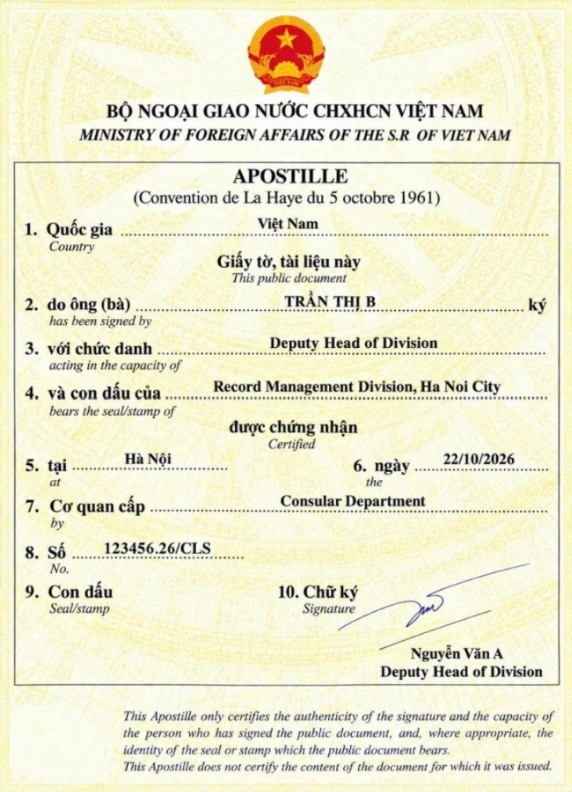
Complete List of Apostille Convention Countries in 2026
According to the HCCH Apostille Convention Status Table, the Convention has 130 Contracting Parties, including Vietnam.
The following list presents the Apostille Convention countries and other Contracting Parties in alphabetical order.
List of 130 Apostille Convention Contracting Parties
| A–F | G–P | P–V |
|---|---|---|
| Albania | Georgia | Palau |
| Algeria | Germany | Panama |
| Andorra | Greece | Paraguay |
| Antigua and Barbuda | Grenada | Peru |
| Argentina | Guatemala | Philippines |
| Armenia | Guyana | Poland |
| Australia | Honduras | Portugal |
| Austria | Hungary | Republic of Korea |
| Azerbaijan | Iceland | Republic of Moldova |
| Bahamas | India | Romania |
| Bahrain | Indonesia | Russian Federation |
| Bangladesh | Ireland | Rwanda |
| Barbados | Israel | Saint Kitts and Nevis |
| Belarus | Italy | Saint Lucia |
| Belgium | Jamaica | Saint Vincent and the Grenadines |
| Belize | Japan | Samoa |
| Bolivia | Kazakhstan | San Marino |
| Bosnia and Herzegovina | Kosovo | Sao Tome and Principe |
| Botswana | Kyrgyzstan | Saudi Arabia |
| Brazil | Latvia | Senegal |
| Brunei Darussalam | Lesotho | Serbia |
| Bulgaria | Liberia | Seychelles |
| Burundi | Liechtenstein | Singapore |
| Cabo Verde | Lithuania | Slovakia |
| Canada | Luxembourg | Slovenia |
| Chile | Malawi | South Africa |
| China | Malta | Spain |
| Colombia | Marshall Islands | Suriname |
| Cook Islands | Mauritius | Sweden |
| Costa Rica | Mexico | Switzerland |
| Croatia | Monaco | Tajikistan |
| Cyprus | Mongolia | Thailand |
| Czechia | Montenegro | Tonga |
| Denmark | Morocco | Trinidad and Tobago |
| Dominica | Namibia | Tunisia |
| Dominican Republic | Netherlands | Türkiye |
| Ecuador | New Zealand | Ukraine |
| El Salvador | Nicaragua | United Kingdom |
| Estonia | Niue | United States of America |
| Eswatini | North Macedonia | Uruguay |
| Fiji | Norway | Uzbekistan |
| Finland | Oman | Vanuatu |
| France | Pakistan | Venezuela |
| Viet Nam |
Important considerations when reviewing the list of Apostille Convention countries:
- Vietnam: The Convention entered into force on September 11, 2026.
- Thailand: Thailand has acceded to the Convention, but it will not enter into force for Thailand until February 28, 2027.
- Germany, Austria, and the Czech Republic: Although they are Contracting Parties, the Convention does not apply between these countries and Vietnam because they have objected to Vietnam’s accession.
- China: The Convention applies to mainland China, Hong Kong, and Macao. Older references suggesting that it applies only to Hong Kong and Macao are outdated.
Which Apostille Convention countries have an application relationship with Vietnam?
According to the Vietnamese Ministry of Foreign Affairs, 125 other Contracting Parties had an application relationship under the Convention with Vietnam as of September 11, 2026.
The figure is calculated as follows:
| Category | Number |
|---|---|
| Total Contracting Parties | 130 |
| Excluding Vietnam | 129 |
| Excluding Thailand, pending entry into force | 128 |
| Excluding Germany, Austria, and the Czech Republic | 125 |
Therefore, being included on the list of Apostille Convention countries does not necessarily mean that documents can be exchanged with Vietnam using an Apostille alone.
Territorial limitations must also be considered. For example, the Convention does not apply to Greenland, which is part of the Kingdom of Denmark, or Tokelau, a territory of New Zealand.
Official sources:
HCCH – Apostille Convention Status Table
Vietnamese Ministry of Foreign Affairs – Apostille Implementation in 125 Countries
Countries That Are Not Parties to the Apostille Convention
Although the Apostille Convention has 130 Contracting Parties, many countries have not yet joined it.
For documents exchanged between Vietnam and countries outside the Convention, traditional consular authentication and legalization procedures generally remain applicable, unless an exemption is available under an international agreement or relevant legislation.
The following is a reference list of countries and territories that are not Contracting Parties to the Apostille Convention.
| Group 1 | Group 2 | Group 3 |
|---|---|---|
| Afghanistan | Haiti | Palestine |
| Angola | Iran | Qatar |
| Benin | Iraq | Sierra Leone |
| Burkina Faso | Jordan | Sri Lanka |
| Myanmar | Kenya | Sudan |
| Cambodia | Kuwait | Syria |
| Cameroon | Laos | Taiwan |
| Republic of the Congo | Lebanon | Tanzania |
| Democratic Republic of the Congo | Libya | Togo |
| Côte d’Ivoire | Madagascar | Turkmenistan |
| Cuba | Malaysia | United Arab Emirates |
| Egypt | Mali | Uganda |
| Eritrea | Mauritania | Yemen |
| Ethiopia | Mozambique | Zambia |
| Ghana | Nepal | Zimbabwe |
| Guinea | Niger | |
| Nigeria |
Note: This list is provided for reference and is not exhaustive. Certain territories and jurisdictions, including Taiwan and Palestine, may require separate consideration of their legal status and document authentication procedures.
When is consular legalization still required?
Vietnam’s accession to the Apostille Convention does not eliminate consular legalization in every situation.
Traditional procedures may still be necessary in the following circumstances:
- Non-Contracting Parties: Documents are exchanged between Vietnam and countries that have not joined the Convention.
- Objections to accession: Documents are exchanged between Vietnam and Germany, Austria, or the Czech Republic, where the Convention does not apply bilaterally.
- Documents outside the Convention’s scope: Certain documents executed by diplomatic or consular agents and administrative documents dealing directly with commercial or customs operations.
- Other applicable legal requirements: Documents are subject to procedures established by relevant domestic legislation or international agreements.
Before preparing documents, individuals and businesses should check not only whether the destination appears on the Apostille Convention countries list, but also whether the Convention applies between the relevant jurisdictions and whether the particular document is eligible.
Conclusion
Vietnam’s implementation of the Apostille Convention on September 11, 2026, represents an important development in simplifying international document authentication.
With 130 Contracting Parties and 125 other parties having an application relationship with Vietnam at the start of implementation, the Convention can significantly reduce the administrative steps involved in using eligible public documents internationally.
Nevertheless, understanding the applicable countries, territorial exceptions, eligible document categories, and translation requirements remains essential.
68 SOLUTIONS – Legal & Travel provides consultation and assistance with Apostille certification, consular legalization, document translation, and notarization.
Whether you need to use foreign documents in Vietnam or Vietnamese documents abroad, our team can help you identify the appropriate procedure for your specific circumstances.
Contact 68 SOLUTIONS for assistance:
Hotline / Zalo / WhatsApp: (+84) 935 595 536
Email: sales@68solutions.vn
Website: https://68solutions.vn/